
Current direction / October 2026
One Halo. Across decks and sites.
Use the approved deck and website direction for every new marketing artifact.
Move to the dot.
Halo takes the shot.
15 close-range images. 8 listing views.
Inter for headings and narrative; IBM Plex Mono for compact technical labels. Native approved deck text may retain its existing Arial caption styling.
Use it through MCP.
Call get_design_context or read halo-brand://design/profiles. The same guidance is returned to agents and shown here.
Slides
At 720×405 pt, use approximately 43 pt side margins, 30–40 pt top margin and a quiet footer. Scale proportionally.
Use Inter semibold/bold headlines and the approved template hierarchy. Headlines typically 28–34 pt, narrative 14–18 pt; preserve existing 11 pt dense card text only in matching native exemplars. Never shrink further to fit. Captions and footers may retain their native smaller roles.
- One argument per slide; avoid repeating the camera story across several slides.
- Use three equal cards for parallel points, two equal cards for pricing, or one dominant product image.
- Keep all UI controls, dot, target crosshairs and capture glow visible in the camera demonstration.
- Put units and geography beside market figures; label modeled TAM and keep retail and fleet opportunities separate.
- Do not require a custom slide compiler for native Google Slides; preserve editable text and shapes.
- Use overview.halocompass.com and its QR code on the final slide.
Websites
- Keep the landing page short and attention-led. Use product, integrations, pricing and research pages for detail.
- Use the actual background video with readable overlays; gradients are allowed only as functional media scrims, not decorative core surfaces.
- Use real capture UI prominently. Show the magenta dot, crosshairs and automatic capture glow.
- Autoplay muted inline demo videos when visible; respect reduced motion and provide accessible pause controls.
- Use warm glass navigation with a solid fallback, restrained corner radii and large product evidence panels.
- Use responsive type and controls; do not copy tiny slide captions into website body text.
- Show Start and Scale as the plan names in cards, buttons, comparison copy and FAQs.
- Lead with appraisals, then show expansion to new and used inventory and complete in-house vehicle photography.
Show the actual product.
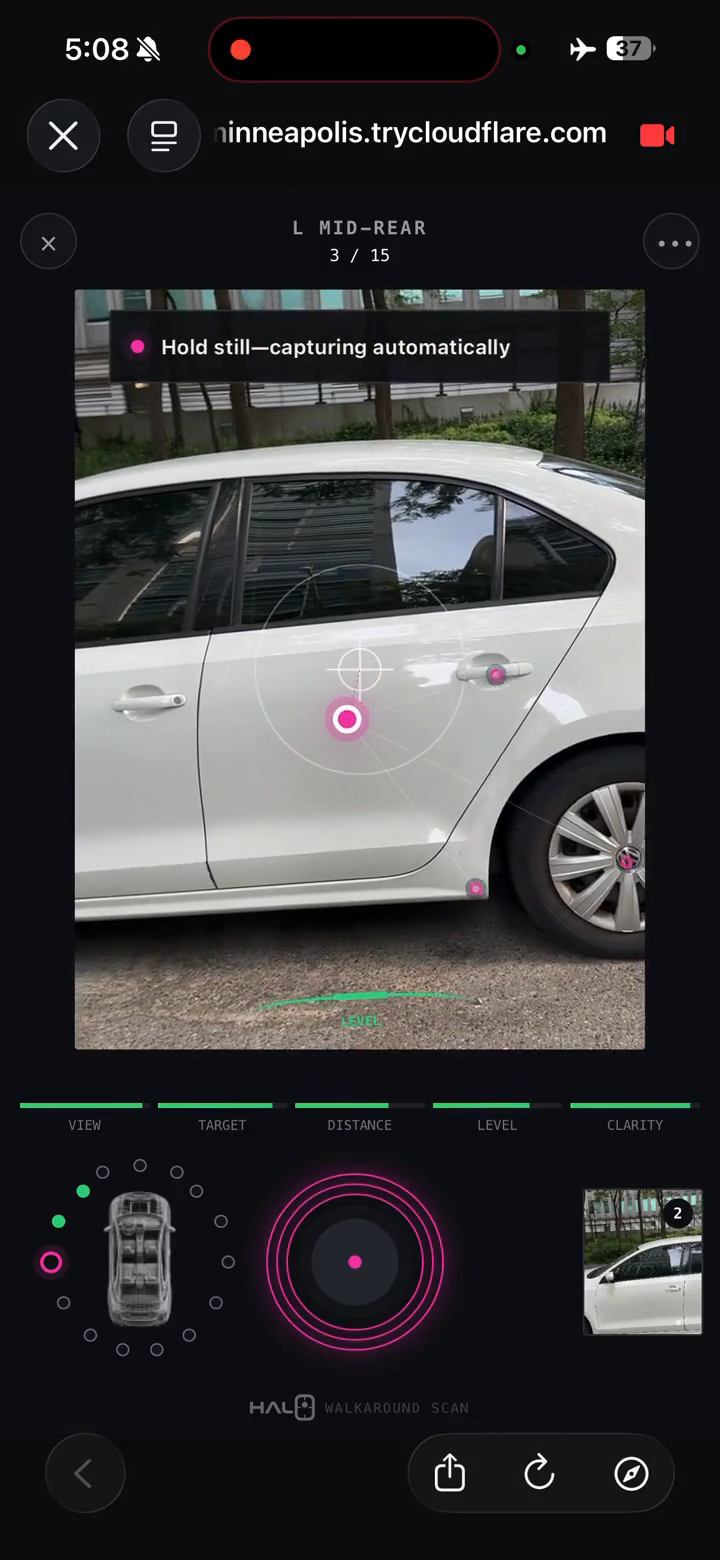
Approved camera frame, including the automatic capture state.
Use real current capture UI with the vehicle-anchored magenta dot, target crosshairs and automatic capture glow. Do not replace it with an invented phone interface.
Use the approved white Jetta composite with VIN and 15 images, blank Notes and no demo-account header. It is an illustrative composite, not evidence of an actual delivered session.
Use the same vehicle across source capture, jellybean/stitching and final presentation views; final presentation follows the jellybean view.
Use the approved finished twin concept with rear-door annotation. Identify it as a roadmap illustration; do not imply that visual polish proves reconstruction accuracy.
Use approved source assets, never rasterized deck text. Preserve intrinsic dimensions and privacy redactions. Do not expose working capture links or scannable session QR codes.
Start and Scale.
Start · $695/month
50 vehicles included. Then $10 per additional vehicle.
Scale · $995/month
100 vehicles included. Then $8 per additional vehicle.
CAD in Canada; identical numeric prices in USD for U.S. dealers.
Per rooftop per month. Allowances count vehicles processed, not vehicles held in inventory.
Problem before product.
Replace the appraisal photo capture already performed for vAuto with Halo’s AI capture camera. Reuse 15 close-range images as eight primary listing views when the acquired vehicle is stocked in, through the configured supported syndication connection.
New and used inventory, recon updates and dealership-wide in-house photography.
The same camera enables the twin.
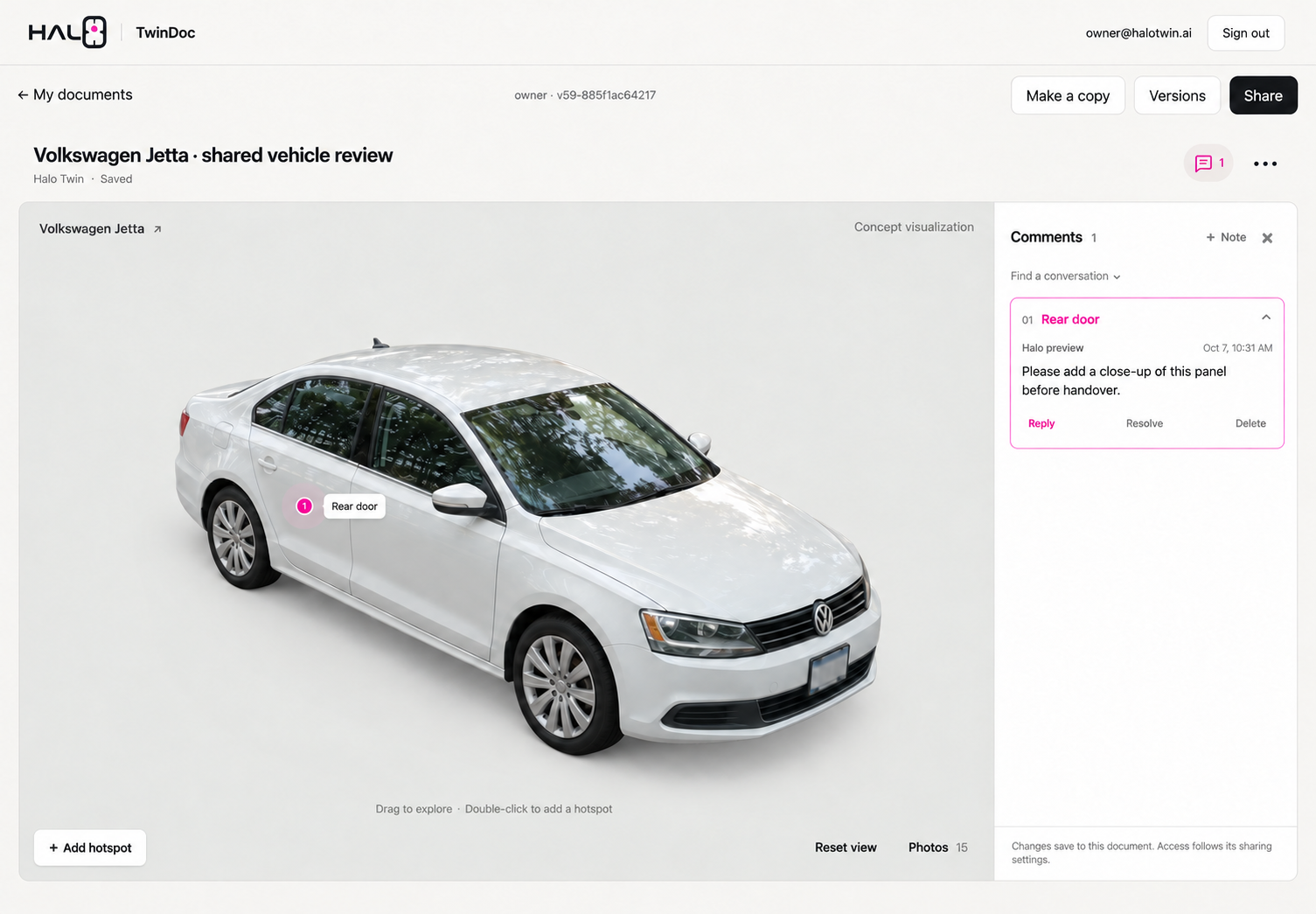
A navigable vehicle representation built from sparse close-range photographs, intended to retain source-pixel detail and anchor observations to vehicle surfaces.
The same vehicle-aware capture camera supplies controlled coverage and source imagery for reconstruction.
R&D roadmap; targeted Q1–Q2 2027, subject to progress.
These twin and SDK uses are planned, not current production capabilities. Pixel fidelity is an R&D objective; do not invent measured accuracy or automated damage detection.